
The Growth Department by Alex Raymond — The Complete Guide
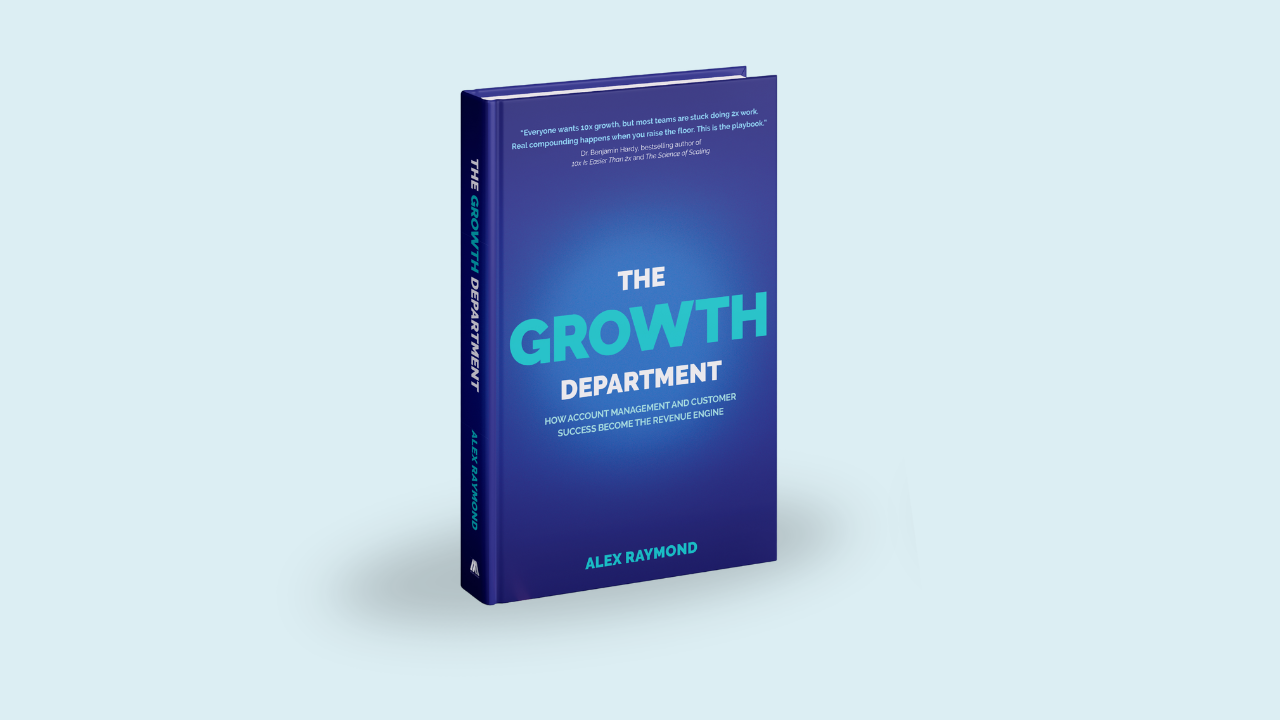
The Growth Department by Alex Raymond is a guide to building a Post-Sale operating system inside a B2B company — the named instruments, the operating mandate, the installation sequence, and the mindset required to run revenue work after the sale. This page covers what the book is, who it is for, how it is structured, and the named concepts that make up the system: the Account Management Tax, Keep, Grow, No Surprises, the Growth Department Mindset, the Growth Department Method, the seven meetings, the Risk Register, and the practitioners whose results anchor the argument.
What is The Growth Department?
Written by Alex Raymond, founder of AMplify and author of The Growth Department.
Sales has named methodologies (MEDDIC, Sandler, Challenger), tooling, ramp time, enablement, and a forecast leadership trusts. Post-Sale has a CRM license and a retention number with no system underneath it. The book argues most companies have Customer Success and Account Management without an installed system, and the missing system is what produces the distance between the revenue Post-Sale delivers and the resources Post-Sale gets. The Growth Department is the name for what gets built when the company decides to operate the way the revenue mix actually demands.
Who should read The Growth Department?
Three audiences.
Chief Customer Officers (CCOs), Vice Presidents of Customer Success, and Heads of Account Management who own a retention number and an expansion target but were never given the operating system to deliver them. The book gives them the Charter, the artifacts, the cadence, and the language they need to make the function legible to the executive team.
Chief Executive Officers, Chief Revenue Officers, and Chief Financial Officers at mid-market B2B companies who can see Net Revenue Retention (NRR) is the lever but cannot see why their team is missing it. The book gives them the economic argument, the maturity model, and the specific operating instruments they should expect their Post-Sale leader to install.
Private equity operating partners running value-creation plans across portfolio companies. Post-Sale is the largest unfunded value lever in most mid-market portfolios, and the book is the installation guide. The Method is what produces hold-period EBITDA expansion and exit-multiple defense.
How The Growth Department is structured
The Growth Department has four parts and eleven chapters. The structure runs from the diagnosis through the function, the mindset, and the operating system.
Part I, The Post-Sale Tax, names the cost of running Post-Sale without an installed system. Chapter 1 covers the blind spots that compound into millions of lost dollars per year. Chapter 2 lays out the economic argument behind expansion as a discipline.
Part II, The Growth Department, names the function. Chapter 3 makes the case for treating Post-Sale as a growth department rather than a service department. Chapter 4 establishes value before revenue as the operating principle. Chapter 5 shows how winning teams actually operate inside that frame.
Part III, The Growth Department Mindset, contains the four arrows. Chapter 6 covers Solve Bigger Problems. Chapter 7 covers Relentless Curiosity. Chapter 8 covers Act Like an Owner. Chapter 9 covers Protect Your Energy.
Part IV, Running the Growth Department, is the operating system. Chapter 10 covers what it takes to build the function. Chapter 11 covers the operating cadence that makes the system durable.
The book closes with the Growth Department Charter (Appendix A), the Internal Pitch Kit (Appendix B), and the 90-Day Install Plan (Appendix C).
What is the Account Management Tax?
The Account Management Tax is the cost a B2B company pays when its Account Management function operates without an installed system, measured in lost expansion, surprise churn, and revenue that never compounds. The tax shows up everywhere and almost nobody measures it.
You know you are paying it when your best Account Manager leaves and three accounts go dark within 90 days because nobody else knows the relationships. You know you are paying it when a renewal you thought was solid turns into a protracted negotiation because the customer champion left and you were not tracking it. You know you are paying it when your CEO asks why retention is down and you do not have a good answer.
The tax is structural. Not a skill problem. A system problem. Ask any Chief Revenue Officer what sales methodology their team runs and they will answer without hesitation: MEDDIC, Sandler, Challenger, SPIN. Ask the Account Management leader the same question and you get a pause. The methodology is missing because the function was never designed to run one. The blind spot is not the team. The blind spot is the company.
The math is unforgiving. New customers are typically unprofitable in their first year. Customer acquisition cost payback periods run 20 to 30 months. Most of the profit comes in after the first renewal. Expansion and renewal cost a fraction of acquisition. A company that allocates capital toward acquisition while starving retention pays the tax every quarter, in full, and writes it off as the cost of growth.
Joanna Hagelberger shows what paying the tax down looks like. As an Account Manager at Vertafore, she inherited a customer worth $50,000 a year. Inside the Old Playbook, that customer would have stayed at $50,000. She asked them where they wanted to be in five years. Two weeks later the customer came back with a five-year plan. Over time, that single account grew to $10 million in annual revenue and more than $100 million in lifetime value to Vertafore. By the way, she did it again at her second company, growing a $200,000 account to $5 million. The repetition is what proves the system.
What is Keep, Grow, No Surprises?
Keep, Grow, No Surprises is the operating mandate of the Growth Department: keep the customers you already have, grow the ones with potential, and run the function so leadership never gets a forecast surprise (For more on this, see How to Improve Forecast Accuracy for Renewals with John Huber). The three are a decision filter, tested against every commitment on the team's calendar.
Keep is the baseline. New customer acquisition costs have roughly doubled over the last decade. Renewals cost about thirteen cents on the dollar earned. The Keep discipline is what makes the rest of the function fundable.
Grow is where the portfolio advances. Expansion is the highest-leverage dollar in the business because it compounds on a customer who has already cleared the payback period. Growing a $200,000 customer to $400,000 produces more contribution margin than landing a new $200,000 logo, in less time, with less risk.
No Surprises is the most underrated of the three. It is what makes the function forecastable, fundable, and trusted at the executive level. The diagnostic for No Surprises is uncomfortable. Positive surprises count as failures too. If a customer adds an unexpected $1 million, you were not asking the right questions, were not tracking the right metrics/signals, did not have a system. The executive team wants predictability. They want a number they can plan against, not a number that occasionally delights them.
Chapter 9 ends with an exercise. Open your calendar for next week and tag every commitment. K for Keep, G for Grow, N for No Surprises, X for none of the above. Most readers run the exercise and discover more than a third of their week is X. They knew it was bad. They did not know it was that bad.
Alex Kane, Senior Account Manager at St. Luke's Health Plan in Idaho, ran the calendar exercise and color-coded her week green for customer-facing and account-advancing work, red for everything else. Almost the whole week was red. She walked her boss through the calendar. She did not complain about being overwhelmed. She framed it around Keep, Grow, No Surprises: here is where my time is going, here is what is not getting done, what can we delegate, stop, or reassign so I can spend more time on what actually drives results. Within weeks, her whole team was running the same exercise. Kane finished the year with 100% renewal on her book and was promoted to Senior.
What is the Growth Department Mindset?
The Growth Department Mindset is the four disciplines the best Account Managers use to retain and grow their accounts: Solve Bigger Problems, Relentless Curiosity, Act Like an Owner, and Protect Your Energy. The arrows are operating disciplines documented from watching high performers who consistently delivered outsized results, given a name and a structure so anyone can learn them.
Solve Bigger Problems
Solve Bigger Problems is the discipline of attaching your work to the customer's actual business outcomes rather than the requests sitting in their inbox. Your customer has a mental box for what you do. They bought your product to solve one specific problem and now that is how you exist in their world. When they need anything bigger, your name does not come up.
The labeled move is the five-year question. The same question Joanna Hagelberger asked her Vertafore customer that broke a $50,000 account out of its operational weeds and grew it to $10 million in annual revenue. The question forces the customer to lift their head and describe where the business is going. The conversation that follows is where the bigger work lives.
Relentless Curiosity
Relentless Curiosity is the discipline of pressure-testing your understanding of each account, because the moment you assume you understand it, your information starts aging. The best Account Managers treat every conversation as a chance to update their map.
Amanda Edington, Vice President of Account Management at Payscale, took a frustrated customer to lunch and asked one question: What else? She kept asking it. Years of unsurfaced issues came out over the meal. None of them had appeared in a single quarterly review. She brought the right team onsite within weeks. Six months later, the customer renewed at double the contract value.
Act Like an Owner
Act Like an Owner is the discipline of treating the revenue in your portfolio as yours to protect and grow, anchored in the equity test: if you held equity in your customer's company, what would you do differently? The Account Managers who expand accounts year after year operate as if they did.
Anthony DeShazor at Givelify had to. The company processed donations for churches and nonprofits and had no auto-renewals, no subscriptions, no contracts. The customer could leave any month. The platform got paid only when the customer raised money. DeShazor anchored every conversation to the customer's true value metric (consistent, loyal donors) and replaced quarterly reviews with the Executive Results Review, a short outcomes-focused meeting tied to that definition. Over eight consecutive quarters, Givelify exceeded its growth targets in key customer segments, often doubling them. Zero customers churned among those who participated in the Executive Results Review.
Protect Your Energy
Protect Your Energy is the discipline of protecting the calendar hours that produce results, because the first three arrows stay theoretical if your week is consumed by low-value work. The Red Calendar exercise (green for customer-facing, red for everything else) is the labeled move. So is the K/G/N/X calendar tag. Both produce the same uncomfortable reveal: most Account Managers spend most of their time on work that does not advance Keep, Grow, or No Surprises.
The arrow describes operating discipline. The leader's job includes protecting the team's calendar from the cross-functional dumping ground. Kane's promotion at St. Luke's followed from being able to point at exactly which hours were going to which work and reclaim the ones that were not earning results.
What is the Growth Department Method?
The Growth Department Method is the three-phase installation system underneath the Mindset: Clarity, Commitment, Cadence, installed in that order, with hard gates between phases, and no minimum viable versions. The skipping is what produces the failure. Commitment artifacts without Clarity become theater. Cadence without Commitment artifacts has nothing to review.
Pillar one: Clarity
Clarity is the phase where the executive team agrees that Post-Sale is the growth function of the business and the company commits to operating accordingly. The Charter gets drafted. Single ownership of Post-Sale revenue gets named. Keep, Grow, No Surprises becomes the operating filter. The Segmentation Plan that follows from 90/10 portfolio thinking gets built, with accounts allocated by tier and resources matched to potential.
The economic argument is what earns Clarity from the executive team. Going from 95% NRR to 115% NRR is, at typical mid-market scale, the equivalent of doubling new logo sales productivity. Companies with NRR above 120% trade at valuation multiples more than 60% higher than the median. Each one-point improvement in NRR adds roughly 12 to 18% in enterprise value over five years. That is the math the CFO is already running.
Pillar two: Commitment
Commitment is the phase where the operational artifacts get installed: the Risk Register, the Top 20% Account Plans (For more on this argument, see Why Your Account Plan Isn't Working and Why Most Account Plans Fall Short.), and the Growth Playbook that turns Clarity into work the team can actually run. Pick a small number of things, do them well, do them forever. Most teams try to do everything at once, burn out in 90 days, and abandon the project. Three artifacts is enough.
Josh Abdulla, Chief Customer Officer at Asana ($700M ARR, 170,000 customers), inherited a churn problem on arrival and built Red Renewals on top of the Risk Register: a non-negotiable bi-weekly meeting where the team works the Register, surfacing risks 9 to 12 months ahead of renewal, with risk categories and proposed resolutions on the table. The standard he set was ±3% forecast accuracy quarterly. Only about 20% of Customer Success organizations are within ±5%. The artifact plus the meeting is what produced the standard.
Pillar three: Cadence
Cadence is the phase where the artifacts become an operating system, through seven recurring meetings that put the work in front of the people who own it on a defined rhythm. The Quarterly Scorecard becomes the artifact the executive team plans against. The forecast gets called and defended monthly. The Risk Register gets worked bi-weekly. The function starts to look like the revenue function the CFO is willing to fund.
Anthony DeShazor's eight consecutive quarters of beating targets at Givelify came from running the Executive Results Review as his Cadence anchor with every key customer. Without Cadence, the Charter becomes a poster and the Account Plans become files nobody opens. With Cadence, the operating instruments earn the airtime they need to produce results.
What are the seven meetings of a Growth Department?
Seven meetings run a Growth Department: the Weekly 1:1, the Weekly Standup, the Bi-Weekly Risk Review, the Monthly Portfolio Review, the Monthly Account Reviews, the Quarterly Executive Briefing, and the Annual Segmentation and Strategy session. Every meeting in the Cadence runs on the same five rules. Same day and time. Same attendees. Written agenda distributed in advance. Written follow-up within 24 hours. Protected and non-optional.
The Weekly 1:1 between the VP of Growth and each Account Manager is 30 minutes, with the Account Manager owning the agenda.
The Weekly Standup is 60 minutes with the full Post-Sale team. Each Account Manager walks their top three accounts in one line each: what changed, what is blocked, what they need.
The Bi-Weekly Risk Review is 60 minutes with the CRO, the VP of Growth, and the heads of departments whose work appears on the Risk Register. This is the meeting Josh Abdulla runs at Asana.
The Monthly Portfolio Review is 60 to 90 minutes with the CRO, VP of Growth, the full team, and Finance. The forecast gets called and defended. This is the meeting that makes the Post-Sale team look like a revenue function to the CFO.
The Monthly Account Reviews are 2 to 4 hours with the team plus invited cross-functional partners. Several Account Plans get reviewed in depth, with each account reviewed once per quarter on a rolling basis. Kristy Devantier at TaleWind Digital runs this format with her company president attending, and reports it as one of the biggest unlocks of her installation.
The Quarterly Executive Briefing is 60 to 90 minutes with the CEO and direct reports. One page of decisions the VP of Growth is asking the executive team to make. Most Post-Sale leaders skip this meeting, and it is the meeting that earns them the seat at the table they keep saying they want. (For more, see How to Create Executive Summaries That Actually Get Read.)
The Annual Segmentation and Strategy session is half-day to full-day with the Revenue Leadership Team and the CFO. The operating model for the next twelve months. Every other meeting on the calendar inherits the decisions made in this one.
What is the Risk Register?
The Risk Register is the artifact that surfaces every identified risk across the customer portfolio in one place, with a named owner, a category, a next action, and a due date, reviewed on the Bi-Weekly Risk Review. Risks fall into standard categories: Value Realization, Relationship and Champion, Product and Adoption, Commercial and Pricing, Competitive, Strategic Fit, Delivery and Service, Macro and External, Internal and Organizational, Contractual.
The discipline is what makes the artifact work. One owner per risk. One category per risk, with no multi-select and no Other bucket. Every risk has a next action and a date. Anything that does not get reviewed is not real.
The categories matter because they let the leader see patterns. If half the items on the Register are Value Realization, that is a product or onboarding problem and the fix lives somewhere other than the Post-Sale team. If a quarter are Relationship and Champion, the team has a coverage problem. The Register surfaces what no individual Account Manager sees. (Further reading: Early Warning Signs of Churn and Customer Churn Prevention Starts Before the Renewal Is at Risk.)
The Hagelberger Vertafore practice anchors the discipline. Running the Register across her portfolio is how she surfaced risks 9 to 12 months ahead of renewal and escalated them before they became churn events. The 200x growth on the original account came from the system she ran around the five-year question, not from the question alone. The Register is what made the relationship durable enough to survive the years before the explosive growth arrived.
Why 73% of B2B revenue comes from existing customers
In a typical B2B company in 2026, about 27% of revenue comes from new logos and 73% comes from customers the company has already won. The 73% generates nearly all of the company's profit. Customer acquisition cost payback periods run 20 to 30 months, and until the customer crosses that line, every new account is an investment at risk. The profit curve compounds after the first renewal.
The valuation math sharpens the argument. Companies with NRR above 120% trade at valuation multiples more than 60% higher than the median. Each one-point improvement in NRR adds roughly 12 to 18% in enterprise value over five years. Improving from 100% to 105% NRR typically yields 15% higher revenue and 20 to 30% higher EBITDA within three years.
By the way, your CFO already knows this. The question they cannot answer is why the team responsible for the 73% has a part-time coach, no playbook, and a CRM license shared across the department, while the team responsible for the 27% has weeks of structured onboarding, named methodologies, and tens of thousands of dollars per rep in annual training. The book hands the Post-Sale leader the language to make that case in the executive team's vocabulary: contribution margin, payback period, NRR, forecast accuracy.
The Capital Reallocation Test is the labeled diagnostic. Every budget cycle, the company decides where to put money, effort, and people. Is the next dollar chasing a customer you do not have yet, or growing one you already won? Most companies keep feeding the expensive dollar and starving the efficient one, then wonder why growth gets harder every year. The Test gives the Post-Sale leader a single question to walk into the CFO's office with.
Which practitioner cases anchor The Growth Department?
Five practitioner cases anchor the book. Each one shows a different piece of the system in operation with documented outcomes.
Joanna Hagelberger built two Account Management functions from scratch in InsurTech. She grew a $50,000 Vertafore account to $10 million in annual revenue (over $100 million in lifetime value) by asking the customer where they wanted to be in five years and then running the system that made the relationship durable. She grew a separate $200,000 account to $5 million at a second company. The case proves the system is repeatable.
Anthony DeShazor at Givelify operated under a business model with no auto-renewals, no subscriptions, and no contracts. He rebuilt the product dashboard around the customer's true value metric (consistent, loyal donors) and replaced quarterly reviews with the Executive Results Review. Eight consecutive quarters of beating targets, zero churn among Executive Results Review participants.
Robert Sproule, Vice President of Account Management at SafetyChain Software, built the Executive Results Review into a 15-minute monthly ritual with the customer's executive sponsor. One food manufacturer spending under $100,000 with SafetyChain identified $6 million in savings through the process. The customer's executives started adjusting the figures upward, telling Sproule his team was underselling the platform's impact.
Amanda Edington, Vice President of Account Management at Payscale, listened as a frustrated customer talked through years of unsurfaced issues over lunch, brought the right team onsite within weeks, and the customer renewed six months later at double the contract value. They are still a customer and recently expanded again.
Alex Kane, Senior Account Manager at St. Luke's Health Plan, ran the Red Calendar exercise, used the visibility to renegotiate her workload with her leader, hit 100% renewal on her book, and was promoted to Senior.
How The Growth Department gets used inside companies
The Growth Department gets used three ways inside companies: bosses buy and distribute it to their teams, teams read it together as a shared operating language, and it appears in onboarding for new Account Managers and Customer Success Managers.
The distribution pattern is the strongest signal of corporate adoption. A VP of Customer Success or Head of Account Management orders 10 or 20 copies and hands them out, so the team is reading from the same playbook with the same vocabulary for the same problems. The book stops being a personal read and starts being a team standard.
The book-club pattern follows. Teams read it chapter by chapter and bring the calendar exercise, the five-year question, and the equity test into actual accounts. The arrows become language people use in meetings. The Charter becomes a draft document. The Risk Register becomes the next operational project.
Onboarding is the third pattern. The book becomes the first-week read for new Account Managers and Customer Success Managers, giving them the operating standard before they get the portfolio. New hires arrive already speaking the language their leader uses. The ramp time on the function shortens.
How to read The Growth Department
The book supports three reading paths depending on time and role.
The 30-minute path
For the reader who has 30 minutes before a leadership meeting. Read Chapter 1 (Blind Spots Costing Millions) to see the problem at the level of how it shows up. Read Chapter 2 (The Irrefutable Economics of Expansion) to see the economic argument. Read the Conclusion (You're in the Driver's Seat) to see the synthesis. These three together give you the diagnosis, the math, and the imperative.
The leader's path
For the Chief Customer Officer, Vice President of Customer Success, or Head of Account Management installing the Method. Read Part II (Chapters 3 to 5) for the function. Read Part IV (Chapters 10 and 11) for the operating system. Read Appendix A (the Growth Department Charter) for the one-page executive-ready definition that becomes the artifact you take to your CEO. The Charter is what gets the function funded.
The IC's path
For the Account Manager or Customer Success Manager who wants the work to feel different next week. Read Part III (Chapters 6 through 9), the four arrows. Each chapter ends with a labeled move that gets applied immediately: the five-year question, the equity test, the Red Calendar, the K/G/N/X calendar tag. Picking one and running it this week is the entry point.
You're in the driver's seat
You now have the full map of the book on one page. The economic argument that wins the budget conversation. The named system that organizes the work. The five practitioner cases that prove the system runs at companies with real customers and real numbers. The reading paths that compress the book to the parts that match your role.
The work from here is yours. Pick one account that matters. Surface one risk that no one else is tracking. Give it an owner. Put a next step on it. Run the playbook this week. You are in the driver's seat. The economics are on your side. The companies that figure this out first are going to pull away from the rest.
Download the audiobook or take the Stress Test
The Growth Department is the Post-Sale revenue operating standard for B2B companies. To hear the origin story directly, listen to The Growth Department: Why Post-Sale Has to Change.
Download the free audiobook of The Growth Department and read the manifesto. Or take the ten-minute Post-Sale Stress Test to see where your function stands across Clarity, Commitment, and Cadence.
A note for executives funding the Method
If you are a Chief Executive, Chief Revenue Officer, Chief Customer Officer, or a private-equity operating partner reading this, the Method is what you should expect your Post-Sale leader to install. The Charter, the three artifacts, and the seven meetings are the operating instruments of a Post-Sale function that works. If your Post-Sale leader cannot produce those artifacts, or cannot tell you which of the seven meetings they run, the function is not installed, and the Post-Sale Tax is being paid every quarter, in full.
For private-equity operating teams running mid-market portfolio companies, the Method is the fastest path to portfolio-wide Post-Sale maturity. AMplify works with PE operating teams at the portfolio level (diagnostic, install, and ongoing operating support) to compress the time to NRR expansion and forecast accuracy across multiple portfolio companies at once.
About the author Alex Raymond is the founder of AMplify and the author of The Growth Department, the operating standard for the function that delivers most of a company’s revenue. He spent a decade building Account Management and Customer Success systems with B2B companies before founding AMplify, where he works with Post-Sale leaders on installing the Growth Department Method. He hosts the Account Management Secrets podcast.