
QBR Mastery
Live cohort starts August 19.
.png)
One of your "green" accounts is already gone
You are going to lose accounts. A budget disappears two levels above your champion. An acquisition rewrites the roadmap. A new CIO arrives with a preferred vendor.
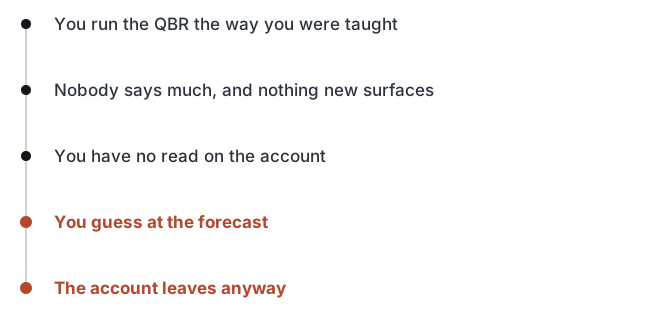
The ones that hurt are the ones you never saw coming, and they are always the quiet accounts. You already work the accounts that worry you. The one that leaves has clean usage, a champion who answers your emails, no open escalations, and a number near the top of your forecast.
You ran QBRs on it. Quarterly, on the calendar, every one of them, with the branded deck from marketing, the dashboards, and the hours of prep. You did everything the job asked of you.
Then the email arrives, with a subject line like "Partnership update." They hope you're well, they've enjoyed working with the team, they wish you all the best, and they have decided not to continue.
Somebody inside that company knew months ago that they weren't going to renew. The decision got made without you, and there was a version of your QBR that would have put you in that conversation. This happens to good Account Managers every quarter, and it is preventable.
"While the client has high product usage and we considered them 'healthy,' we uncovered that they aren't meeting revenue goals. Something we hadn't been aware of, but definitely should have been."
THE VEHICLE
Is this account going to renew?
This is the one question your QBR is designed to answer. Look at what you have to answer it with.
Usage data.
Activity is not the same as commitment. Customers can use your product every day and still churn.
NPS.
Inconsistent data, often months old. NPS has almost zero correlation to retention.
The health score.
Lots of data points from various systems, and not one of them is forward-looking.
Your CRM notes.
Just a record of what you already knew. Nothing in your CRM will tell you something you haven't heard yet.
An AI summary of the last six months.
A faster read of the same old material, without human judgement.
These indicators aren't going to tell you where you stand with the customer while there's still enough time to do something about it.
A QBR is a live conversation focused on the future.
The customer shares goals, challenges, and needs — in their words.
You ask detailed follow-up questions.
A dashboard gives you one answer. A conversation gives you the answer behind the answer.
You see what no call recorder captures.
How fast they answered. What they skipped. Body language.
If a concern comes up, you can address it in the meeting.
You answer it on the spot, instead of finding out three months later that nobody did.
You see risk while it's still small.
You have quarters to work on it instead of weeks.
Which makes the QBR your single best read on whether an account will renew.
THE EVIDENCE
Only if the right people are in the QBR
The best renewal signal is who attends your QBRs.
"If your last two QBRs are with the C-level, you are 7x more likely to open a cross-sell or upsell opportunity. If they're with someone more junior, you are 4x more likely to churn the customer."
Guy Rubin — Founder of Ebsta · on the Account Management Secrets podcast
Senior people have the full picture, the budget, and the ability to make decisions. They share their goals and give clear feedback. Junior people can't make significant commitments, and often they sit in the meeting because someone above them didn't want to be there.
Which means that attendance is itself a decision your customer is making about you.
THE C-SUITE QBR
Run the QBR the C-suite wants to attend
You already run QBRs competently. Getting an accurate read on a renewal depends on who joins the meeting, and that is something you can control.
You get sent to who you sound like. Lead with their business instead of your product, and the conversation is about their revenue, their costs, and the pressure their board is applying. Those are the things senior people own, so those are the meetings senior people join.
Then you can ask the questions that give you an accurate forecast: what is changing in their strategy, where the budget pressure sits, and what would make this a ten-year relationship. You leave with a position on the account and the evidence behind it.
The C-suite QBR is the only way to get a read on an account while you can still do something about it.
THE DIFFERENCE
Master the craft
Most QBR training teaches you how to run a meeting. QBR Mastery teaches you how to accurately forecast a renewal.
Every other program teaches skills: agenda templates, question banks, presentation technique. Skills are important, but in order to get different results you need to work at a deeper level.
QBR Mastery is the only program that trains judgment rather than technique.
When you work on how you think about the QBR, how you behave in it, and what you are able to do in it, the meeting itself changes. You'll walk into your next QBR to find something out rather than to prove you did your job. Your customer spends the hour talking about their business instead of listening to a recap of yours. Senior people come, because a meeting like that is worth their calendar, and you walk in knowing it.
You are playing a different game.
"Throughout my 15 years in Account Management I've found many different resources — AMplify has the most robust systems, and gives you the ability to act on these things instantly."
Daniel Sapien — Account Management and Customer Success Leader
THE COMPLETE METHOD
The QBR Mastery Program
QBR Mastery is a complete system for running QBRs your customer's senior decision-makers attend and forecasting renewals you can defend. It includes live working sessions, the toolkit, AI tools, and lifetime access to the method.
SESSION I · AUGUST 19
Get in front of the right people.
Learn how to get the C-suite in your QBR for the whole meeting — the invitation, the champion, and what you do when they don't come.
Then: send a real invitation on a real account
SESSION II · SEPTEMBER 2
Get them talking.
Skip the reporting and understand what's really going on at the account. Fewer slides, less talking, and the facilitation technique that makes senior people open up.
Then: run one QBR in the new shape
SESSION III · SEPTEMBER 16
Know where you stand.
Uncover risks and opportunities while you can still do something about them — and turn what you heard into a forecast number you can defend.
Opens by dissecting the meetings you ran
You are going to get so good at QBRs that you'll never have to guess at a renewal again.
If you don't, get your money back. Attend the three sessions live, apply what you learned to a real account, and if you are still guessing, we'll refund your money.
"The Account Management team renewed 100% of our ARR contract clients this year, and we're on track to exceed our revenue goal by over 8% — in a year with a lot of challenges. So much of this is possible because of what I've learned in AMplify."
Kristy Devantier — Managing Director, TaleWind Digital
Who QBR Mastery is built for
You're in the right place if
Don't enroll if
This isn't QBR 101. There's no lesson on how to build an agenda or structure a deck, and if that's what you need, this will be over your head and under your expectations at the same time.
Small-value, high-volume books don't have the senior relationships this depends on.
THE CHOICE
So now you have a decision to make
Everything above is either true or it isn't. If it's true, here is what the next twelve months look like.
FROM HERE
Change what the QBR is for
Senior people attend. You come out knowing where the account stands. You raise a risk in July that would have hit in December, and you do something about it.
The dread goes. You walk into the forecast review with an answer instead of a guess, and you stop lying awake over which account is the one.
You stop being surprised.
The only question is whether you're ready to do something about it.
THE OFFER
Join the founding cohort
FOUNDING COHORT
$999
$1,499 after August 12 · One payment · Lifetime access to everything
Retain one $50,000 account you'd otherwise have lost and it pays for itself fifty times over.
That's the conversation with your manager, and it takes about forty-five seconds. And then you still have next year, and the next account, and the rest of your book.
Your customers are setting next year's budgets right now.
QBR Mastery starts in August so you still have time to change your 2026 numbers. Wait for the next cohort and you won't see results until the middle of 2027. $999 holds until August 12, then it's $1,499. This is the first time QBR Mastery has run outside AMplify, and the founding rate goes with it.
"Alex helped me reignite my passion for Account Management."
Alex Raymond has worked with hundreds of companies and thousands of Account Managers over more than a decade, across nearly every kind of B2B business. He is the author of The Growth Department and hosts the Account Management Secrets podcast.

PLUS
The QBR Mastery Toolkit
In addition to the three live sessions, you also get the full set of templates and resources we use in the program.
Everything you need to run your next QBR differently
Stop preparing for the QBR you've always run
The Modern QBR Mindset · 7 QBR Reframes
Recognize a risk while the customer is still talking
Risks to Listen For During QBRs
Know whether the QBR worked, without waiting for the renewal to tell you
The QBR Engagement Scorecard
Have everyone clear on their job before the invitation goes out
The RACI Chart for QBR Preparation
Turn what you heard into things that actually happen
Key Steps for Post-QBR Follow-Up
Run the method inside the AI environment you already work in
The QBR Claude Skill
Show your manager what you completed
Certificate of completion
Have the whole argument on your desk
A physical copy of The Growth Department, shipped worldwide
AND IT DOESN'T END WHEN THE SESSIONS DO
Lifetime access to the entire method.
Every recording, every resource, every update, yours permanently. Still there when your book changes.
RISK REVERSAL
Your 30-Day Money-Back Guarantee
Attend the three sessions live, apply what you learned to a real account, and if you are still guessing at your renewals, write in within 30 days of the final session and get your money back.
And the toolkit is yours either way. Refund or not, you keep every resource, every recording, and the templates.
"The results speak for themselves. Account Managers who were struggling before are now actively implementing what they learned and we're seeing real improvements in their performance and confidence."

"AMplify reignited my passion for Account Management. Its tools helped me plan strategically and confidently handle challenging situations. In a recent review, I used AMplify techniques to navigate a client's restructuring, gaining insights that deepened our partnership."

"AMplify gave me clear steps to refine my account strategy. These insights led to two early renewals, and I'm now revamping my annual strategic planning process to deliver even greater results in the coming year."

OBJECTIONS
Every reason not to do this
"I don't have time for this right now."
It's 4.5 hours across four weeks, and the program's whole posture is subtraction: fewer slides, less prep, shorter meetings. You've spent more than 4.5 hours building the deck for one QBR nobody senior attended.
"We're heading into Q4. I'll do this next year."
Punt this to next year and you won't see results until 2027. You can't change a churn inside the quarter it lands, which is why this has to change before the decision gets made.
"I've been doing this for twelve years."
Then you're better than most people at the QBR you currently run. But nobody ever taught you a method. You inherited a template and improved it by repetition. Experience makes you sharper at the QBR you're already running. It doesn't tell you the QBR is the wrong shape.
"Aren't QBRs dead? That's all I see on LinkedIn."
The old one is. The forty-five-slide recap with six people from your side and one from theirs deserves everything anyone has said about it. But that verdict killed a format, not the conversation underneath it, and that conversation is still the only thing that gives you an early read.
"We don't even call them QBRs."
Then call them annual strategic reviews, executive reviews, value reviews, or results reviews. Run them quarterly, twice a year, or once. The name and the frequency don't matter. What matters is a real conversation with senior people, early enough that you can still act on what you hear.
"My accounts are different."
Senior people guard their time, champions need coaching, and risk hides in what nobody says out loud. That holds in every industry this program has run in. You leave with a small number of changes to how you think and how you run the meeting, and you apply them to your own accounts.
"This is a lot of money."
Compared to what? One saved $50,000 account returns fifty times the investment to your company. That conversation with your manager takes about forty-five seconds, and we'll send you language you can forward if you want it. Worth knowing before you sit on it: $999 holds until August 12, and the price is $1,499 after that.
"I'm going to miss at least one of the live sessions."
We record every session and you keep them permanently, so you can catch the one you miss. Protect the three dates if you can, though. The live sessions are where the group works on your actual accounts, a recording can't do that part, and attending all three live is what the guarantee is conditioned on.
FOR LEADERS
Bringing your team
One Account Manager through QBR Mastery makes their own accounts better. A whole team through it makes your forecast better, and gives you one language for talking about risk across the book.
Seats are $999 each. Teams of five or more get a dedicated onboarding and strategy call before the first session, plus progress reporting throughout. Teams of ten or more add a 30-day application session where the group works through their own accounts together.
Team enquiries · Five seats or more
THE DECISION
Master your QBRs and stop guessing about the renewal
QBR Mastery, the complete method for a QBR the C-suite attends
Three live 90-minute sessions on August 19, September 2 and September 16
The QBR Mastery Toolkit, usable on your next meeting
Lifetime access to everything, including updates
$999 through August 12, then $1,499
30-day guarantee, and the toolkit is yours either way
Founding cohort closes August 12 · Live work begins August 19